


Walk into two accounting firms in Central — one with a mismatched letterhead, a business card printed on flimsy stock, and a website that looks nothing like its office signage; the other with every document, card, and digital touchpoint clearly part of the same coherent system. You’ll trust the second one more within seconds, often without consciously knowing why. That instinctive trust is what corporate identity design is built to produce.
What Is Corporate Identity?
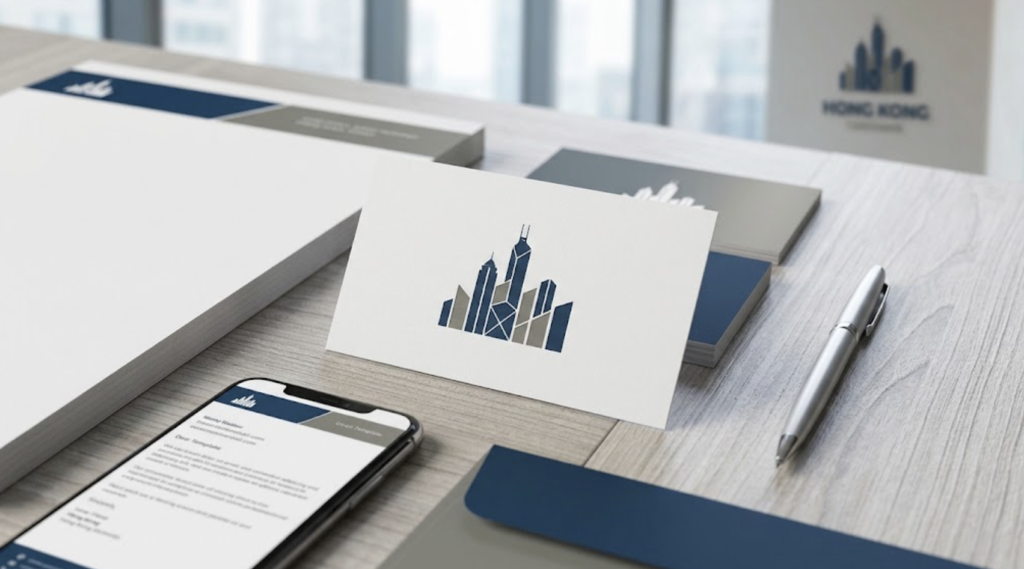
Corporate identity is the complete, consistent visual and behavioural system a company presents to the world — encompassing its logo, colour palette, typography, business documents, signage, and often its internal culture and communication style. It’s closely related to brand identity, but with a specific emphasis: corporate identity tends to focus on how a business presents itself in formal, professional, and operational contexts — documents, offices, uniforms, vehicles — rather than purely consumer-facing marketing.
For a law firm, financial services company, or B2B business, corporate identity is often the primary way clients experience the brand at all — there’s no flashy packaging or retail storefront, just documents, meetings, and a website.
The Core Components of a Corporate Identity System
Logo and logo variations — the primary mark plus variations for different contexts (horizontal, stacked, icon-only for small applications).
Colour and typography system — a defined palette and type hierarchy applied consistently, not chosen ad hoc for each new document.
Business stationery — business cards, letterheads, envelopes, and email signatures that visually align.
Document templates — proposal templates, presentation decks, invoices — the unglamorous documents that clients actually see constantly.
Signage and environmental application — office reception, meeting room branding, building directory listings.
Brand guidelines — the reference document ensuring every new piece of collateral, created by anyone on the team, stays consistent.
Why Corporate Identity Matters More for Professional Services Firms
Consumer brands get to build trust through product experience — you can taste the food, feel the packaging, use the product. Professional services firms — law, accounting, finance, consulting — don’t have that advantage. A prospective client is often evaluating the firm based almost entirely on how it presents itself before any actual work has been delivered.
This is precisely why inconsistency is more damaging in this category than almost any other. A mismatched proposal template, an outdated logo on the website versus the office signage, or business cards that look like they came from a different company than the letterhead — these small inconsistencies compound into a subtle but real erosion of perceived competence.
Case study — brand consistency in hospitality: When VincDesign developed the identity for Regent Hong Kong, the requirement extended well beyond a logo — it needed to translate consistently across print collateral, digital booking interfaces, and physical signage, all while maintaining the premium positioning the hotel demanded. The same discipline that made that identity work applies directly to corporate identity for professional services: every touchpoint has to reinforce, not dilute, the same impression.
“Corporate identity is often the least glamorous part of brand work — nobody gets excited designing an invoice template. But for professional services clients especially, it’s frequently the thing that determines whether a prospective client trusts you enough to sign.” — Vince Cheung, Founder, VincDesign
Corporate Identity vs. Branding: A Quick Distinction
The terms overlap significantly and are often used interchangeably, but if you want a precise distinction: branding is the broader strategic and emotional positioning of a company (what it stands for, how it wants to be perceived). Corporate identity is the applied, systemic visual execution of that positioning specifically across business and operational contexts. You need branding decisions made first; corporate identity is how those decisions get implemented consistently across every document and touchpoint a client or employee encounters.
What a Corporate Identity Project Typically Includes
- Audit — reviewing all existing touchpoints (documents, signage, digital assets) for inconsistencies
- System definition — establishing or refining the logo, colour, and typography system
- Template development — building out business cards, letterheads, proposal decks, and other core documents
- Guidelines documentation — a reference guide ensuring future materials, created internally or by other vendors, stay on-brand
- Rollout support — helping the team transition existing materials to the new system
Frequently Asked Questions
What’s the difference between corporate identity and branding?
Branding is the strategic positioning and emotional territory a company owns. Corporate identity is the systemic visual execution of that positioning across business documents, signage, and operational touchpoints specifically.
Does a small business need a formal corporate identity system?
If client trust is built primarily through professional presentation — as is the case for most B2B and professional services businesses — yes. Even a lean system (logo, one template, consistent business cards) is far better than none.
How much does corporate identity design cost in Hong Kong?
A focused corporate identity project (stationery and core templates, built on an existing logo) typically ranges from HK$20,000–60,000. A full system including brand guidelines and signage application costs more, depending on scope.
How often should a corporate identity be refreshed?
There’s no fixed timeline, but common triggers include: the business has meaningfully repositioned, the current identity looks dated relative to competitors, or a merger/rebrand has occurred. Many businesses reassess every 5–10 years.
Can corporate identity be updated without a full rebrand?
Yes. If the core logo and brand positioning still hold, you can refresh just the applied system — templates, stationery, guidelines — without the cost and disruption of a complete rebrand.
Need a corporate identity system that holds up across every client touchpoint? VincDesign has built brand and corporate identity systems for hospitality, professional services, and F&B businesses across Hong Kong since 2013. Contact VincDesign →
